Sustainability
Sustainable where it counts.
No claims we can't prove. Hollow-core precast cuts waste, saves water and lasts longer — every statement here is backed by a standard or industry research.
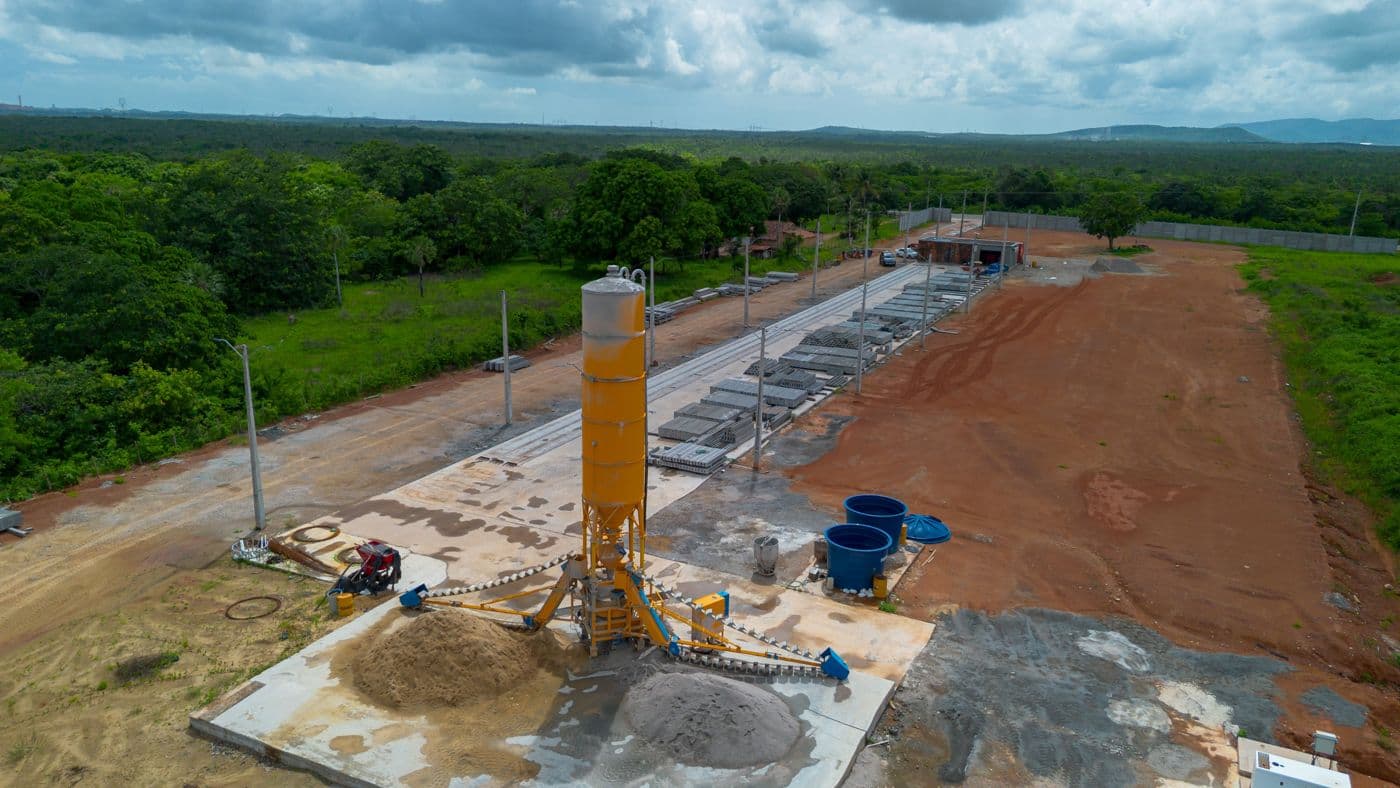
AFDC production yard — São Gonçalo do Amarante, CE.
Why it matters, in Brazil
Six reasons — sourced.
Recyclable — and Brazil needs it
In Brazil, construction & demolition waste (RCD) reaches 40–70% of all municipal solid-waste mass, and CONAMA 307 bans it from common landfills. The AFDC panel is Class A: recyclable as aggregate. And ABNT NBR 15116:2021 now permits recycled aggregate even in structural concrete — the loop closes.1,2,3
Less waste on site
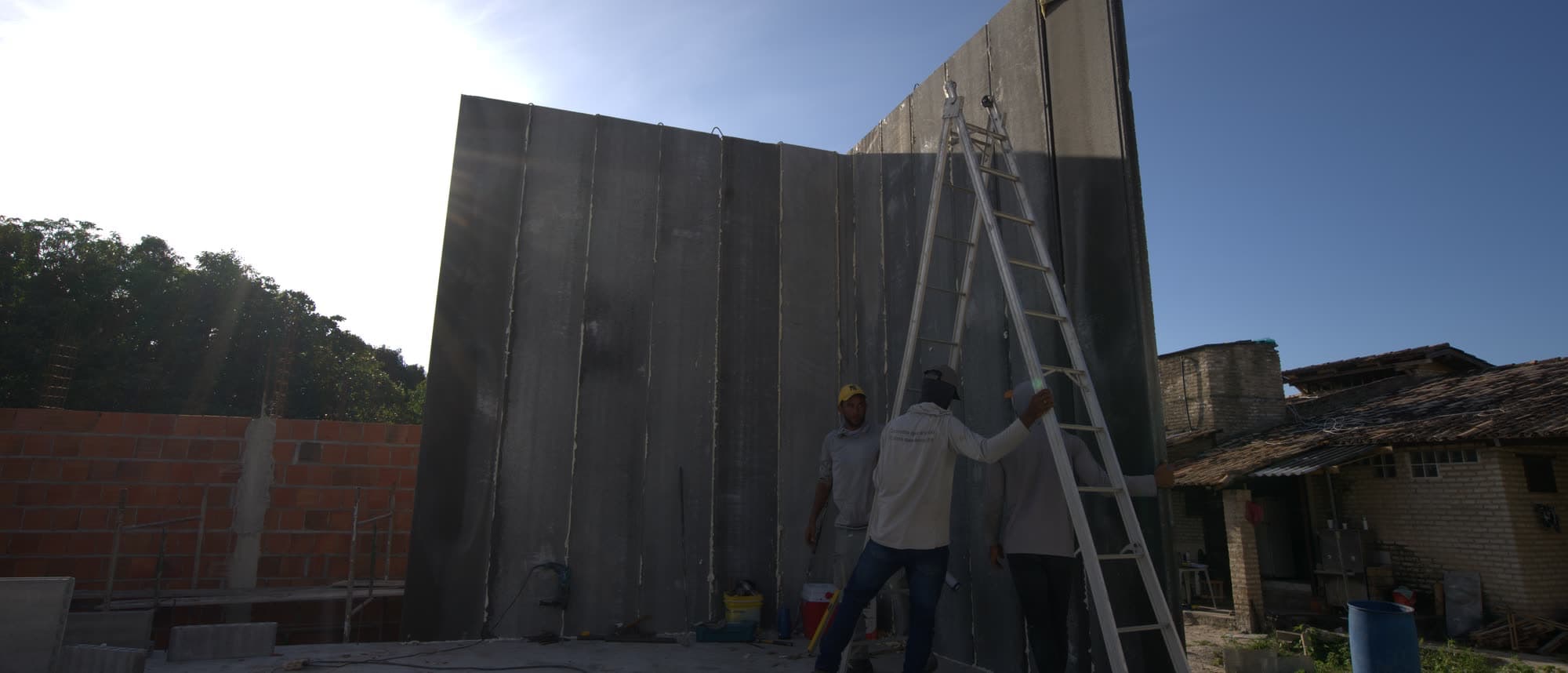
Traditional masonry generates a lot of debris. Factory production and dry assembly drastically cut on-site RCD versus cast-in-place concrete.4,1
Water — critical in the semiarid
Construction uses about 15% of the world's fresh water, and Ceará's semiarid lives with scarcity. Dry assembly uses minimal water on site, and precast plants recirculate about 95% of their process water.5,6
Hollow-core uses less material
The extruded hollow-core panel puts concrete only where the structure needs it: about half the section is void and the piece is ~50% lighter than the solid equivalent — less cement, less steel and a leaner foundation per m².7
Thermal comfort for this climate
ABNT NBR 15575 splits Brazil into eight bioclimatic zones. In the heat of the Northeast, concrete's thermal mass dampens indoor temperature and tends to cut cooling demand. AFDC's own performance numbers stay in Quality — calculated, to be confirmed by testing.8
Lasting decades is sustainable
Precast structures routinely last 50 to 100 years with little maintenance. A material that lasts twice as long halves its impact over time — and lowers the housing-warranty liability.9
Honestly
Cement's carbon, no spin.
Cement is carbon-intensive — we don't hide it. But Brazilian cement is among the lowest-CO₂-intensity in the world, and the sector's Net Zero Roadmap (SNIC/GCCA, launched at COP30) targets neutrality by 2050. Hollow-core uses less concrete, and AFDC's own EPD/LCA is in study — we'll publish it once audited. No number we can't back.10
Sources
- 1.CONAMA 307/2002 — gestão de resíduos da construção civil
- 2.ABNT NBR 15116:2021 — agregados reciclados em concreto (Cimento Itambé)
- 3.Agregado reciclado de pré-moldados (qualidade) — J. Cleaner Production
- 4.Pré-moldado vs. concreto in loco — estudo comparativo (LCA)
- 5.Uso e disponibilidade hídrica no semiárido — Embrapa
- 6.Reúso de água em fábricas de pré-moldado — PCI Sustainability
- 7.Eficiência alveolar (~50% de vazios / peso) — Elematic
- 8.ABNT NBR 15575 — desempenho térmico / zonas bioclimáticas
- 9.Durabilidade do pré-moldado (50–100 anos) — Coreslab
- 10.Roadmap Net Zero da indústria do cimento (SNIC/GCCA, COP30) — ABCP
Talk to the factory
How much is your project losing without seeing it?
Request a quote or schedule a visit to the factory in Pecém, 60 km from Fortaleza.
The factory · Pecém — São Gonçalo do Amarante, CE